Bank of Canada Held Rates Again: What It Means for Your Mortgage This Summer
June 12, 2026 | Posted by: Keith Leighton
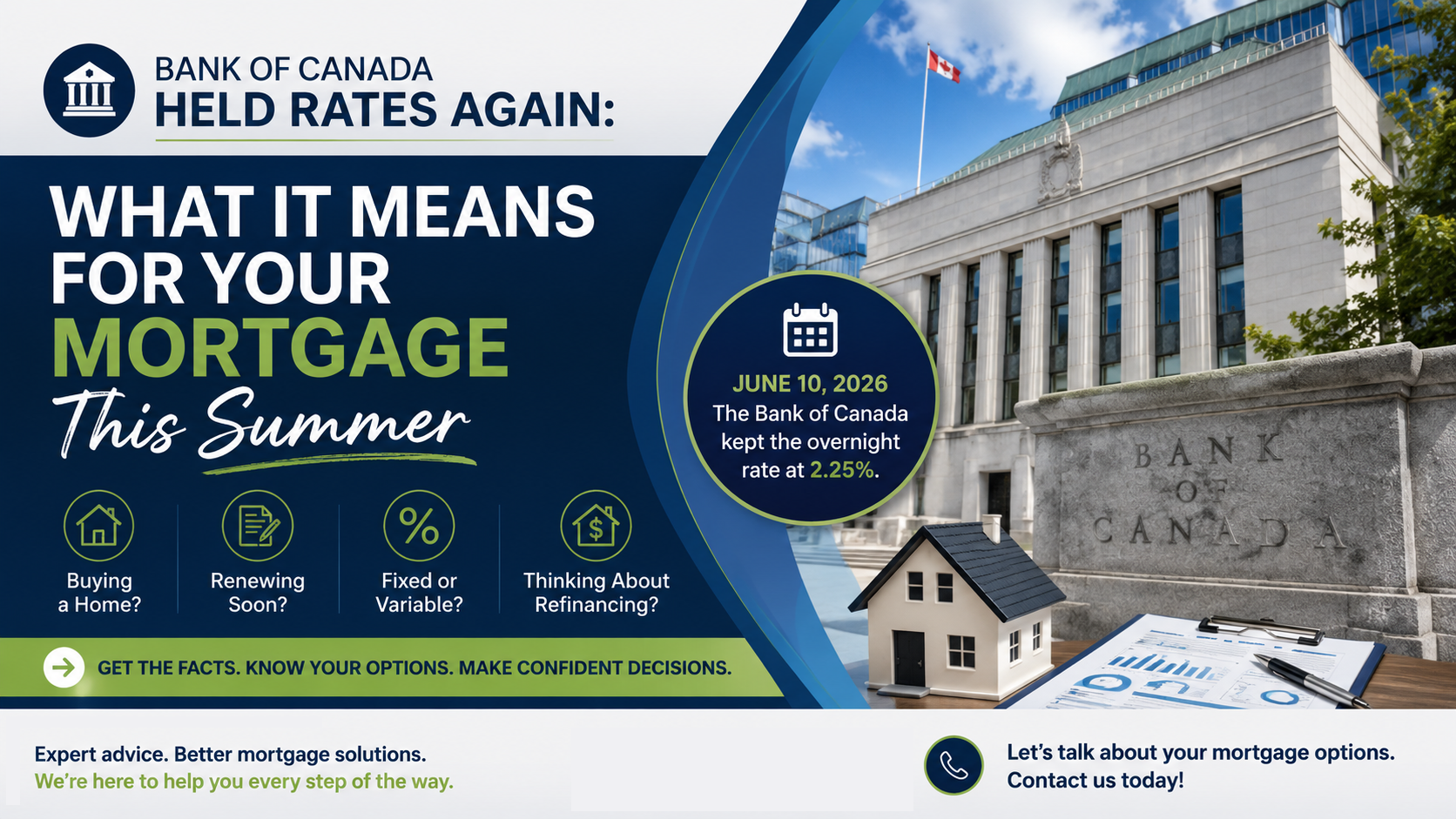
Bank of Canada Held Rates Again:
What It Means for Your Mortgage This Summer
The Bank of Canada has held its policy rate again, leaving the target for the overnight rate at 2.25%. For many Canadians, this may sound like good news. After all, no rate increase means no immediate jump in payments for most variable-rate borrowers.
But a rate hold does not mean the mortgage market is standing still.
If you are buying a home, renewing your mortgage, refinancing, or trying to decide between a fixed and variable rate this summer, this latest announcement is worth paying attention to. The key takeaway is simple: rates may be stable for now, but your mortgage strategy still matters.
What Did the Bank of Canada Do?
On June 10, 2026, the Bank of Canada maintained its target for the overnight rate at 2.25%.
This is the rate that influences short-term borrowing costs across the country. It has a direct impact on things like:
• Variable-rate mortgages
• Adjustable-rate mortgages
• Home equity lines of credit
• Lines of credit
• Some personal loans
When the Bank of Canada holds rates, lenders usually keep their prime rates unchanged as well. That means many borrowers with variable-rate products may not see an immediate change to their payments.
However, fixed mortgage rates are a different story.
Does This Affect Fixed Mortgage Rates?
Not directly.
Fixed mortgage rates are influenced more by the bond market than by the Bank of Canada’s overnight rate. That means a rate hold does not automatically lead to lower fixed rates.
Fixed rates can move based on several factors, including:
• Government bond yields
• Inflation expectations
• Economic growth
• Investor confidence
• Global market uncertainty
• Lender competition
So, while the Bank of Canada holding rates may create a sense of stability, fixed-rate mortgage shoppers should not assume that rates will automatically drop.
If you are considering a fixed rate this summer, it is still important to compare your options and understand the features of the mortgage, not just the rate itself.
What This Means for Variable-Rate Mortgage Holders
For variable-rate borrowers, the rate hold likely means your rate stays the same for now.
If you have an adjustable-rate mortgage, your payment typically changes when prime changes. Since the Bank of Canada did not raise or lower rates, your payment may remain unchanged.
If you have a variable-rate mortgage with fixed payments, your monthly payment may also stay the same. However, the portion going toward interest versus principal can still matter. When rates are higher, more of your payment may go toward interest, which can slow down how quickly you pay down your mortgage.
This is a good time to review:
• Your current mortgage rate
• Your remaining amortization
• Your monthly cash flow
• Your comfort level if rates were to rise later
• Whether switching to a fixed rate makes sense
A rate hold gives borrowers breathing room, but it does not remove the need for a plan.
What This Means if You Are Buying This Summer
If you are planning to buy a home this summer, the rate hold may help create a bit more confidence. Mortgage payments are not suddenly becoming more expensive because of this announcement, which can make budgeting easier.
That said, buyers should still be cautious.
Before making an offer, make sure you understand:
• How much you can comfortably afford
• What your monthly payment could look like
• How property taxes, heating costs, and condo fees affect approval
• Whether your pre-approval includes a rate hold
• How long that rate hold lasts
• What conditions should be included in your offer
A pre-approval is especially important in a market where rates can still shift. It helps you shop with more confidence and gives you a clearer picture of your real budget.
The goal is not just to get approved. The goal is to get a mortgage that fits your life.
What This Means if You Are Renewing Soon
If your mortgage is coming up for renewal this summer or later in 2026, now is the time to start reviewing your options.
Many homeowners are renewing from lower-rate mortgages into today’s higher-rate environment. Even with the Bank of Canada holding steady, your renewal offer may still be higher than what you are used to.
Before signing your lender’s renewal letter, consider asking:
• Is this the best rate available to me?
• Should I choose a shorter or longer term?
• Does a fixed or variable rate make more sense?
• Can I adjust my amortization to manage payments?
• Are there penalties or restrictions I should know about?
• Would another lender offer a better fit?
Your renewal is not just paperwork. It is an opportunity to reset your mortgage strategy.
In many cases, your current lender may send a renewal offer that looks simple and convenient. But convenience does not always equal the best option. Comparing lenders before you renew can potentially save money and give you more flexibility.
Should You Choose Fixed or Variable?
There is no one-size-fits-all answer.
A fixed rate may be better if you want payment stability and predictability. This can be especially helpful if you have a tight budget, a growing family, or simply prefer knowing exactly what your payment will be.
A variable rate may be worth considering if you are comfortable with some uncertainty and want the potential to benefit if rates fall in the future. However, variable rates also come with risk if rates move higher.
When choosing between fixed and variable, think about:
• Your monthly budget
• Your income stability
• Your risk tolerance
• How long you plan to stay in the home
• Whether you may need to break the mortgage early
• Your confidence in handling possible payment changes
The lowest rate is not always the best mortgage. Features, flexibility, penalties, and long-term fit all matter.
What About Refinancing?
If you are thinking about refinancing this summer, the Bank of Canada’s rate hold may provide a more stable environment for reviewing your options.
Homeowners often refinance to:
• Consolidate higher-interest debt
• Access equity for renovations
• Lower monthly payments
• Restructure their mortgage
• Fund major life expenses
• Combine a first and second mortgage
Refinancing can be helpful, but it should be reviewed carefully. There may be penalties, legal costs, appraisal fees, or changes to your amortization.
The real question is not just “Can I refinance?” It is “Does refinancing improve my overall financial position?”
A mortgage broker can help compare the numbers before you make a decision.
A Rate Hold Is Not a Reason to Pause
It can be tempting to hear that the Bank of Canada held rates and decide to wait. But waiting is not always the best strategy.
For buyers, waiting could mean missing the right property or facing changes in home prices. For renewers, waiting too long could limit your options. For homeowners considering refinancing, delaying could mean continuing to carry expensive debt longer than necessary.
A rate hold gives you a chance to make decisions with less urgency. It should not be a reason to ignore your mortgage.
What Should You Do Next?
If you have a mortgage decision coming up this summer, now is a good time to review your options.
Here are a few smart next steps:
• Get pre-approved before shopping for a home
• Review your renewal options early
• Compare fixed and variable scenarios
• Ask about rate holds
• Understand penalties before signing
• Look beyond the lowest advertised rate
• Speak with a mortgage broker before making a final decision
Mortgage decisions should be based on your personal situation, not just the latest headline.
Final Thoughts
The Bank of Canada holding rates again brings some stability to the market, but it does not mean every borrower should make the same move.
If you are buying, renewing, or refinancing this summer, the best mortgage strategy depends on your goals, your budget, and your comfort level with risk.
At Ideal Mortgage, we help Canadians compare their options and understand what today’s rate environment means for their specific situation. Whether you are looking for your first home, renewing an existing mortgage, or exploring a refinance, the right advice can make all the difference.
Before you make a mortgage decision this summer, let’s look at the numbers together. Contact your Ideal Mortgage expert today!